

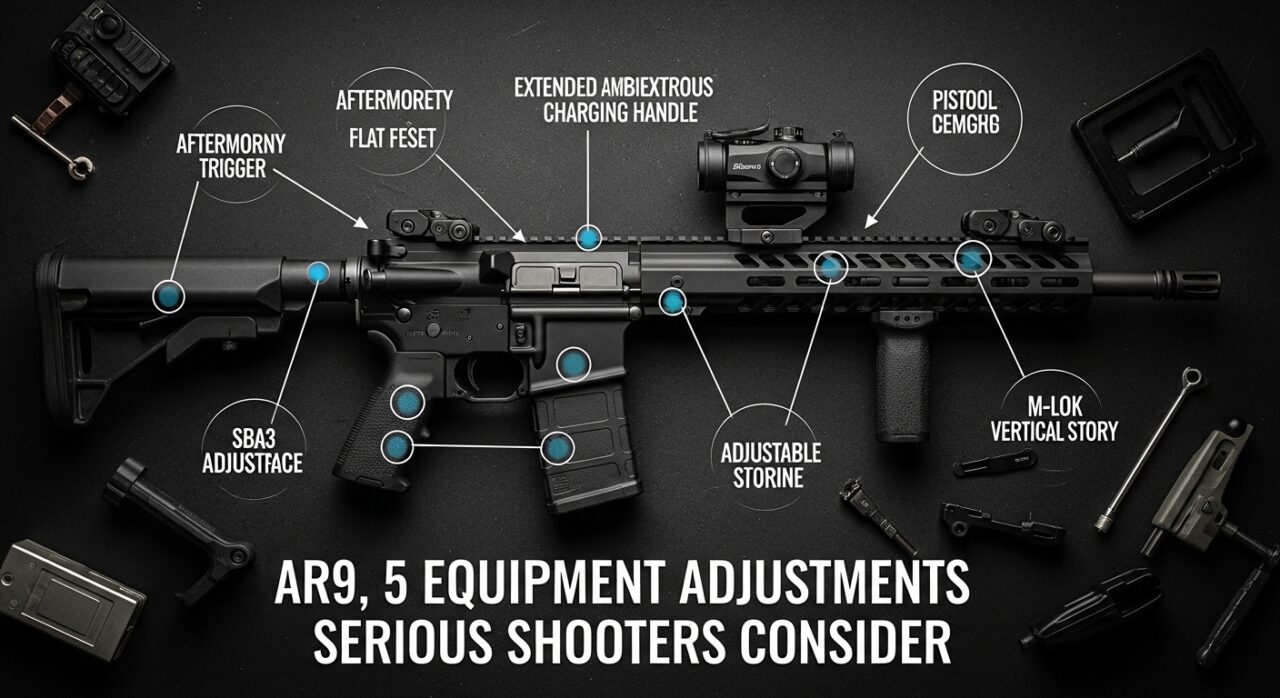
Whether you are hitting the range for competitive sport or focusing on tactical precision, the difference between a good shot and a great one often comes down to the details. Serious shooters know that while skill is paramount, the equipment you use and how it is configured can significantly impact performance.
Refining your setup isn’t just about buying the most expensive gear; it’s about customization and optimization. Here are five equipment adjustments that experienced shooters consider to elevate their accuracy, comfort, and speed.
1. Upgrading the Trigger Mechanism
The trigger is the primary interface between the shooter and the firearm, making it one of the most critical components for accuracy. A heavy or gritty trigger pull can cause the muzzle to move just as the shot breaks, throwing off aim.
Serious shooters often replace factory triggers with match-grade alternatives. These upgrades offer a lighter pull weight, a cleaner “break,” and a shorter reset. A crisp break allows for a more predictable shot, while a short reset enables faster follow-up shots. This adjustment essentially minimizes the physical effort required to fire, allowing the shooter to maintain better focus on sight alignment and breath control.
2. Optimizing the Recoil Management System
Managing recoil is essential for maintaining sight pictures during rapid fire. If your firearm jumps too much, it takes longer to get back on target. Adjusting the recoil system is a common way to mitigate this.
This can involve swapping out buffer springs or changing buffer weights to tune the cycling of the action. For those using pistol caliber carbines, such as an ar 9, fine-tuning the buffer system is particularly important to smooth out the blowback action. Additionally, adding a high-quality muzzle brake or compensator can redirect gas to counteract muzzle rise, keeping the firearm flatter and more controllable during strings of fire.
3. Customizing Optic Placement and Height
Simply mounting a scope or red dot sight isn’t enough; it must be positioned correctly for the shooter’s specific body mechanics. Incorrect placement can lead to “scope shadow,” neck strain, or a slow acquisition of the sight picture.
Adjusting the eye relief—the distance between the eye and the optic—ensures a full field of view without straining. Furthermore, riser mounts are often used to bring the optic to a natural eye level. This is particularly relevant for shooters wearing ear protection or helmets, where a standard low mount might force an uncomfortable cheek weld. A properly adjusted optic allows the shooter to bring the rifle up and immediately see the reticle without hunting for it.
4. Enhancing Grip Texture and Ergonomics
Control starts with the grip. If your hands slip due to sweat, rain, or recoil, accuracy suffers. Factory grips are often designed to be “one size fits all,” which rarely fits anyone perfectly.
Shooters often apply stippling (creating a textured surface on polymer frames) or add grip tape to increase friction. Beyond texture, the size of the grip matters. Interchangeable backstraps allow users to adjust the grip circumference to fit their hand size, ensuring the trigger finger lands naturally on the trigger face. A secure, consistent grip builds the foundation for repeatable accuracy.
5. Refining the Sling Setup
For tactical shooters and competitors involved in dynamic stages, a sling is more than just a carry strap; it’s a stability tool. However, an ill-fitted sling can snag on gear or restrict movement.
Adjusting the tension and attachment points of a two-point sling allows for greater maneuverability. Shooters often set up their slings to be loose enough for easy transitions between shoulders but tight enough to provide tension support when taking a shot. Using Quick Detach (QD) mounts allows for rapid removal or reconfiguration, ensuring the equipment adapts to the specific demands of the course or environment.
Dialing in your equipment is a continuous process of trial and error, but the results are worth the effort. By focusing on triggers, recoil management, optics, ergonomics, and accessories, you can create a platform that feels like a natural extension of your body. Take the time to analyze your shooting style and make the necessary tweaks to unlock your full potential on the range.