

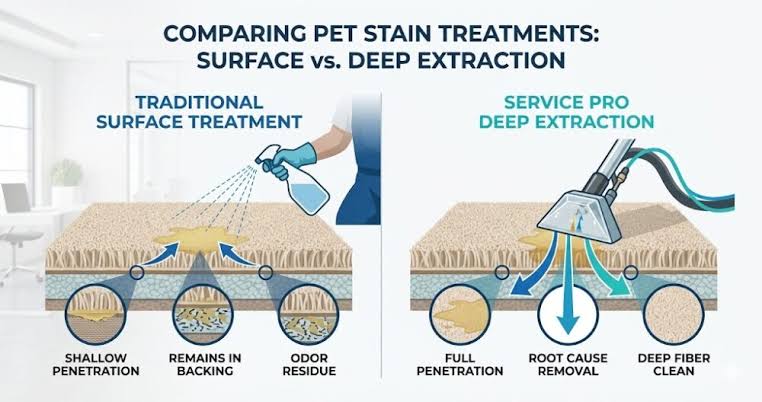
Carpet pet stains and odor represent one of the most persistent and frustrating household cleaning challenges, specifically because the approaches that seem most thorough often don’t address what’s actually causing the problem. The stain might lighten. The immediate smell might reduce. But the odor returns, the stain sometimes reappears slightly, and the process repeats until the carpet is replaced out of frustration with the cycle.
This cycle has an explanation rooted in what urine actually is and how it interacts with carpet materials at different stages of its presence. Understanding this explains why certain approaches fail and what actually interrupts the cycle permanently rather than temporarily.
CJS Cleaning Solutions handles pet stain and odor removal regularly and the pattern of what works versus what doesn’t is consistent enough to be laid out clearly rather than leaving pet owners to discover it through expensive trial and error.
Why Pet Urine Is a Complex Problem
Fresh urine is primarily water with dissolved waste compounds including urea, uric acid, creatinine, and other biological components. In this fresh state, it’s relatively straightforward to address because the compounds are still soluble and can be extracted with appropriate treatment.
As urine dries and ages, the biology changes. Bacteria in the urine begin breaking down the urea, which produces ammonia. The smell intensifies during this phase. Then, over days to weeks, the uric acid component forms salt crystals as it dries. These uric acid crystals are the core of the long-term odor problem because they’re not water-soluble, don’t respond to normal cleaning products, and reactivate when exposed to moisture, which is why cleaned areas smell again when humidity rises.
What Standard Cleaners Do and Don’t Do
Standard carpet cleaning products, including most consumer-grade pet stain removers, address the soluble components of urine effectively in fresh stains. They clean the urea and remove immediate visible staining. What they don’t do is break down uric acid crystals, because this requires enzymatic action rather than standard surfactant cleaning.
This is the mechanism behind the returning odor cycle. The visible stain and immediate smell improve after treatment because the soluble components were addressed. But the uric acid crystals remain in the carpet fibers and padding, and when moisture contacts them again, whether from humidity, subsequent cleaning, or pet resoiling, the smell returns as the crystals reactivate.
Enzymatic Cleaners and How They Work
Enzymatic cleaners contain specific enzymes that break down the organic compounds in urine, including the uric acid component that standard cleaners leave intact. This is chemical breakdown rather than physical cleaning, which is why these products need adequate contact time to work rather than being applied and immediately wiped away.
For the enzymatic reaction to reach the uric acid crystals that have penetrated into carpet fibers, the product needs to be applied in sufficient quantity to saturate to the same depth the original urine penetrated, and allowed to remain wet long enough for the enzymatic breakdown to occur. Under-application or premature drying stops the process before completion, which is why proper enzymatic cleaning of carpet pet stains requires more product and more time than people typically allocate.
The Padding Problem
Urine from dogs and cats penetrates through carpet fibers into the carpet pad beneath at a rate that often means more urine is in the pad than in the visible carpet surface. Surface treatment, even thorough enzymatic cleaning of the carpet fibers, doesn’t reach contamination in the pad if the product doesn’t penetrate to that depth.
Heavily contaminated carpet pad is often the source of persistent odor that carpet surface treatment repeatedly fails to eliminate. In these situations, pad replacement may be more practical and effective than continued treatment attempts, particularly for large stains or repeated incidents in the same area over extended time.
Why Hot Water Extraction Is Important for Pet Stain Removal
The extraction component of professional carpet cleaning is what removes the residue of both the urine compounds and the cleaning product applied to address them. Adequate extraction with professional-grade equipment removes significantly more material from carpet fibers than surface blotting or consumer machine extraction can achieve.
Inadequate extraction leaves both residual cleaning product and partially broken-down urine compounds in the carpet, which themselves become sources of odor and attract pet resoiling because pets can detect the residual smell of previous elimination even when humans can’t.
Preventing Recurrence in the Same Area
Pets return to elimination sites based on smell detection that’s far more sensitive than human perception. Even successfully cleaned and odor-free to human perception, a previously soiled area may retain enough residual scent markers to attract resoiling from the same pet. Breaking this pattern requires either thorough enough odor elimination to address the pet’s detection threshold, not just the human threshold, or physical deterrents that make the area less accessible or appealing.
The thoroughness of enzymatic treatment and extraction significantly affects whether the residual scent markers remain below the pet’s detection threshold, which is part of why professional treatment is more effective than consumer product application at interrupting the resoiling cycle.
CJS Cleaning Solutions approaches pet stain and odor removal with the product approach, equipment, and contact time management that the chemistry of this particular problem actually requires, producing results that hold up rather than temporarily improving and then cycling back to the same frustrating baseline.